
Cracked Tooth in Epsom:
Find the Crack, Save the Tooth
A sharp jolt when you bite down. A twinge with cold drinks that disappears in seconds. Pain that comes and goes — and your dentist can't quite see anything. That pattern is almost always a cracked tooth, and the earlier we catch it, the more options you have.
Sharp pain on biting, or pain that lingers after the trigger goes away? A crack can spread into the nerve within days. Call us for a same-day appointment: 01372 679192.
A Cracked Tooth Doesn't Heal On Its Own
Cracked teeth are one of the most common — and most missed — causes of dental pain in adults over 30. The classic picture: a sharp, short pain when you bite on something hard or at a certain angle, that vanishes the moment you stop biting. Sometimes it's a sensitivity to cold that won't quite settle. Sometimes there's nothing visible at all.
The reason cracks are tricky is that a tooth can flex slightly when you bite. Each time it flexes, the crack opens, the nerve gets irritated, and the pain spikes. Left alone, the crack widens — and once it reaches the pulp, you're looking at root canal treatment or extraction instead of a simple repair.
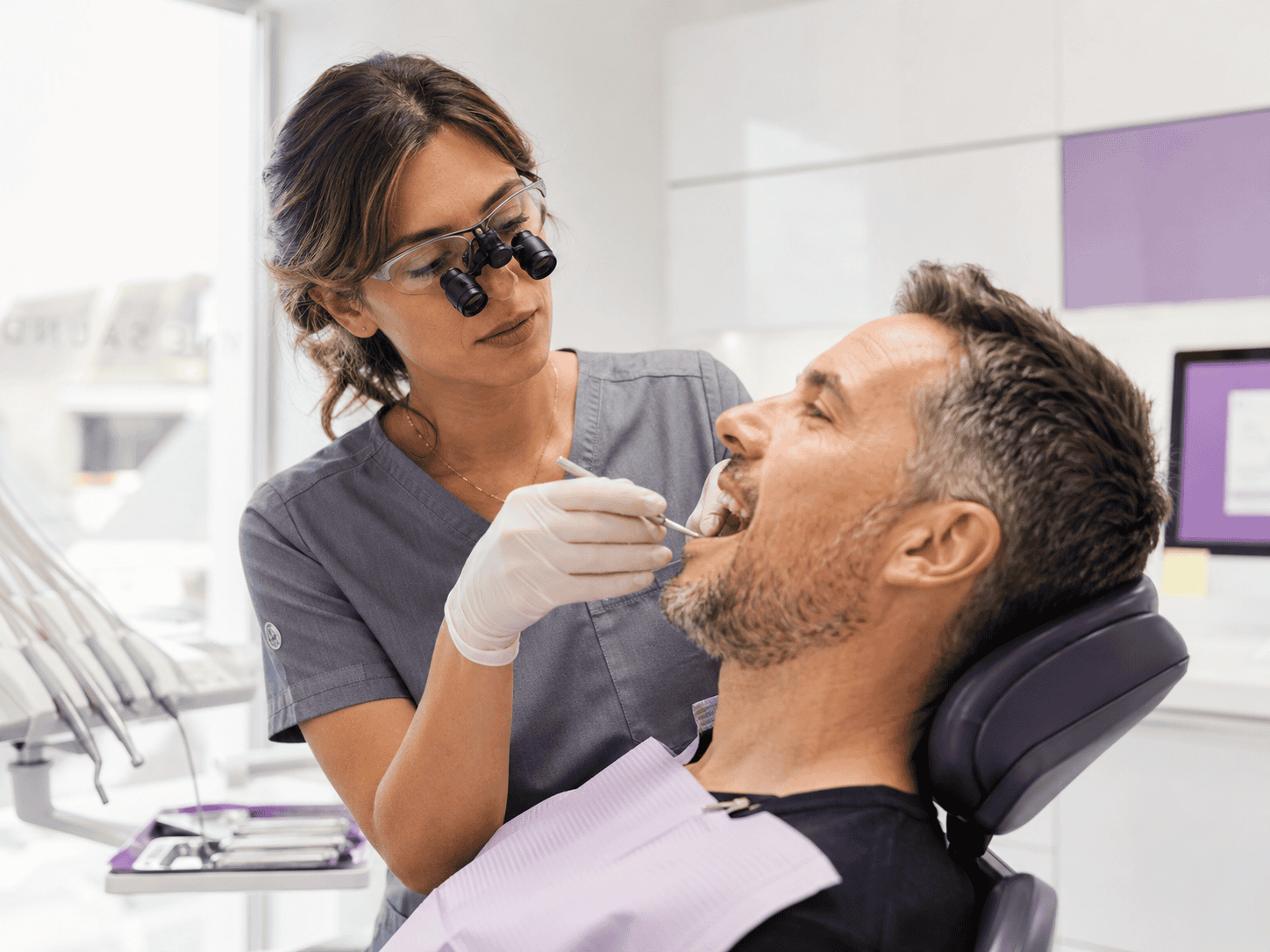
What an assessment involves: a focused bite test, magnification, and a targeted X-ray where it adds clarity. Most cracks are diagnosed on the first visit and we'll talk you through the options — and the cost — before anything is booked. See our fees for full transparency.
The Five Types of Cracked Tooth
"Cracked tooth" covers a spectrum — from harmless surface lines to deep splits that can't be saved. The right treatment depends on exactly which one you have.
Craze Lines
Tiny vertical lines in the enamel of front teeth. Very common in adults, painless, and usually need no treatment. If they bother you cosmetically, polishing or a light composite bonding can mask them.
Fractured Cusp
A piece of the chewing surface — usually around an existing filling — has broken off. Often surprisingly painless because the nerve isn't involved. Typically restored with an onlay or crown to protect what's left of the tooth.
Cracked Tooth (Cracked Tooth Syndrome)
A vertical crack running from the chewing surface down towards the root. The hallmark symptom is sharp pain when biting, especially on releasing the bite. If we catch it before the crack reaches the pulp, a crown usually saves the tooth.
Split Tooth
A cracked tooth left untreated for too long — the crack has now separated the tooth into two distinct sections. Sometimes one segment can be saved with root canal treatment and a crown, but more often the tooth needs to come out.
Vertical Root Fracture
A crack starting at the root and travelling upwards. Symptoms are usually mild and confusing — perhaps a deep gum tenderness, or a small pimple on the gum. Most commonly diagnosed via X-ray and unfortunately cannot usually be saved. Spotting it early protects the bone for a future implant.
Pain that lingers, throbs, or keeps you awake? A crack that's reached the nerve is a true emergency — read our guide to toothache in Epsom and the warning signs of a dental abscess, or call us straight away.
What a Cracked Tooth Actually Feels Like
Cracks rarely have one obvious sign. Most patients describe two or three of these — and the pattern is more telling than any single symptom:
- A sharp jolt when you bite down on something hard — especially nuts, seeds, crusty bread, or ice. The classic giveaway.
- Pain on release, not on biting — pain that hits as you stop biting, not while you press down. Almost diagnostic of cracked tooth syndrome.
- Brief sensitivity to cold drinks that doesn't linger — different from worn enamel sensitivity, which is usually broad and gradual.
- Pain that comes and goes for weeks or months — you can go days without noticing, then one bite sets it off.
- Trouble pinpointing which tooth it is — cracks can refer pain along the jaw, so even you might not be sure which side it's on.
- Discomfort with sweet or sticky foods — sugar passing through the crack can irritate the nerve directly.
- Food keeps getting stuck in one specific spot — a sign the crack has opened a small gap or a piece of cusp has gone.
- An old filling that suddenly feels different — large fillings weaken the surrounding tooth, and the first crack often starts at the edge.
- A small pimple or tender spot on the gum near the tooth — can signal a deeper crack that's letting bacteria in, or an early abscess forming.
The pattern is the diagnosis. If two or more of these sound familiar, a proper exam — with a bite test and often an X-ray — usually finds the culprit. New patients always welcome.
Why Teeth Crack in the First Place
Cracks almost never come from one cause. Usually it's a weakened tooth meeting a sudden force, or repeated stress over many years. Identifying yours stops it happening to the next tooth too.
Grinding & Clenching
The single biggest cause we see. Hundreds of pounds of force per square inch, every night, on the same teeth. Grinders almost always crack a back tooth eventually — a night guard prevents the next one.
Large Old Fillings
A big silver filling acts like a wedge — every bite gently flexes the surrounding tooth. After 15–25 years that flex eventually splits the cusp. Replacing oversized fillings with crowns or onlays prevents it.
Biting Something Unexpectedly Hard
An olive pit, a popcorn kernel, a piece of bone in a stew, a hard nut, ice cubes. One bad bite is enough — especially on a tooth that's already been weakened by previous treatment.
Trauma to the Face
Sports impacts, falls, cycling accidents, or even a knock to the chin can crack a front or back tooth. Sometimes the crack is invisible for weeks until symptoms appear. A mouthguard during sport is the simplest prevention.
Sudden Temperature Changes
Hot coffee then cold water. Ice cubes after a warm meal. Enamel expands and contracts with temperature, and rapid swings can create stress lines that develop into full cracks, especially in already-restored teeth.
Age & Years of Use
Teeth are remarkably tough but not infinite. After 40–50 years of chewing, micro-fatigue accumulates. Most cracked teeth we see are in patients over 40 — it's a normal part of teeth ageing, and entirely manageable when caught early.
How We Treat a Cracked Tooth at Epsom Smiles
The right treatment depends on where the crack is, how deep it goes, and whether the nerve is involved. We use a bite test, magnification, and X-rays where needed to map the crack — then choose the least invasive option that gives you a tooth you can confidently bite on for years.
- Polish or no treatment — for craze lines. If the crack is purely cosmetic and confined to the enamel, no treatment is needed. We'll monitor it at each check-up to make sure it isn't deepening.
- Bonding for small chips and surface cracks. A thin layer of tooth-coloured composite seals the crack and rebuilds the surface. Quick, painless, and tooth-coloured. Best for minor cracks where the rest of the tooth is structurally sound. See our composite bonding page.
- White filling — for cracks that involve part of the chewing surface. Where a small piece has fractured off but the tooth is otherwise strong, a white filling rebuilds the missing area and protects the rest from further chipping.
- Onlay or crown — the gold standard for cracked tooth syndrome. If the crack runs through a cusp or across the chewing surface, the tooth needs to be "hugged" by a crown or onlay to stop it flexing. This is what saves the tooth long-term — patients are usually pain-free within days.
- Root canal — when the crack has reached the nerve. If the nerve is irreversibly inflamed (constant pain, pain at night, sensitivity that won't settle), modern root canal treatment removes the infected nerve and the tooth is then crowned. The tooth stays in place and works normally.
- Extraction and replacement — only when the crack has gone too deep. If the crack extends below the gum or splits the root, the tooth can't be saved. We'll take it out gently and plan the replacement — usually a dental implant or bridge — at the same appointment so you know what's ahead.
Curious about cost? Our fees page has full pricing for crowns, root canals, and onlays, and interest-free payment plans are available for treatments over a certain value. We'll always give you a clear written price before any treatment starts — no surprises.
What to do tonight while you wait: chew on the other side, avoid anything hard or sticky, skip very hot and very cold drinks, and take paracetamol or ibuprofen if you need it. Don't ignore it — cracks travel, and the longer you wait, the more likely the nerve gets involved.
Why Choose Epsom Smiles for a Cracked Tooth?
-
We Find the Crack — Not Just Guess
Cracks can be missed on a standard exam. We use a bite test, transillumination, magnification and targeted X-rays so the diagnosis is precise — and the treatment matches it.
-
Same-Day Diagnosis Where Possible
If you call us with a suspected cracked tooth, we'll do everything we can to see you the same day. The earlier a crack is found, the simpler the fix.
-
Conservative First, Always
We don't jump straight to a crown if a smaller restoration would do. And if a root canal can save the tooth, we'll always offer that before extraction. You'll see the X-rays and decide with us.
-
Gentle Care for Anxious Patients
A cracked tooth often comes with anxiety — about the pain, the cost, and what the dentist might say. The team is calm and patient, and we'll explain every step before we do anything.
-
Transparent Pricing — No Surprises
You'll know the cost of any recommended treatment before we start. Our fees page is fully transparent, and finance options are available when needed.
"Had a sharp pain for weeks every time I bit down on the left, but two other places couldn't find anything. Epsom Smiles diagnosed a hairline crack on the first visit, fitted a crown, and the pain disappeared completely. Should have come here first."Google Review
Cracked Tooth FAQs
No. Unlike bone, tooth enamel and dentine can't repair themselves once cracked. The crack will either stay the same (rare) or — far more commonly — gradually widen each time you bite. Treating it early usually means a simple restoration. Leaving it almost always means a bigger, more expensive treatment later.
The pattern is the giveaway. Sensitive teeth usually affect several teeth, are triggered by cold or sweet things, and the discomfort is broad and short. A cracked tooth typically affects one tooth, is set off by biting rather than temperature, and the pain often hits as you release the bite. If two or more biting symptoms apply, it's worth getting checked.
It depends on the symptoms. A small chip with no pain isn't urgent — it can wait a week or two. But pain on biting, lingering pain, hot sensitivity, throbbing, swelling, or a visible fracture line that's spreading are urgent, because the crack can reach the nerve quickly. If you're unsure, call us — we'll triage on the phone and book you in the same day if needed.
Most of the time, yes — particularly if the crack is caught early. Cracks limited to the enamel or upper dentine are treated with bonding, a filling, an onlay, or a crown. Cracks that have reached the nerve need root canal treatment plus a crown. Only cracks that extend below the gum line or split the root are usually beyond saving.
No — only deeper or more extensive cracks need a crown. Surface cracks, small chips, and minor fractures can often be repaired with bonding or a white filling. Crowns are recommended when a crack runs through a cusp or across the chewing surface, because they "hug" the tooth and stop it flexing. We'll always choose the most conservative option that gives a lasting result.
Cracks often run in the same direction as the X-ray beam, which makes them effectively invisible on a 2D image. That's why we don't rely on X-rays alone — we use a bite test (you bite on a small wedge against one cusp at a time), magnification, and transillumination (a bright light shone through the tooth) to find cracks the X-ray misses.
Almost always, yes. Each bite flexes the tooth and the crack widens, even by tiny amounts. Bacteria then track down the crack, the nerve becomes inflamed, and what could have been a crown becomes a root canal — or, if the crack reaches the root, an extraction. Early treatment is dramatically simpler and cheaper.
It depends entirely on what the crack needs — anything from a small bonding repair up to a crown or root canal plus crown. We give a clear, written price before any treatment starts, and finance is available for larger treatments. Full prices are on our fees page, and our payment plans spread the cost interest-free over several months.
Three big wins: get a custom night guard if you grind or clench, replace large old fillings before they fail, and avoid chewing very hard things (ice, hard sweets, pen lids, popcorn kernels). Wearing a mouthguard during contact sports prevents trauma-related cracks. Regular check-ups also let us spot and crown a weakened tooth before it actually fractures.
You May Also Be Looking For
Think You Have a Cracked Tooth?
Let's Catch It Early & Save It.
A bite test, magnification, and (if needed) an X-ray usually find the crack on the first visit — and the earlier we catch it, the more we can save. New patients always welcome.
Or email us at enquiries@epsomsmilesdental.co.uk